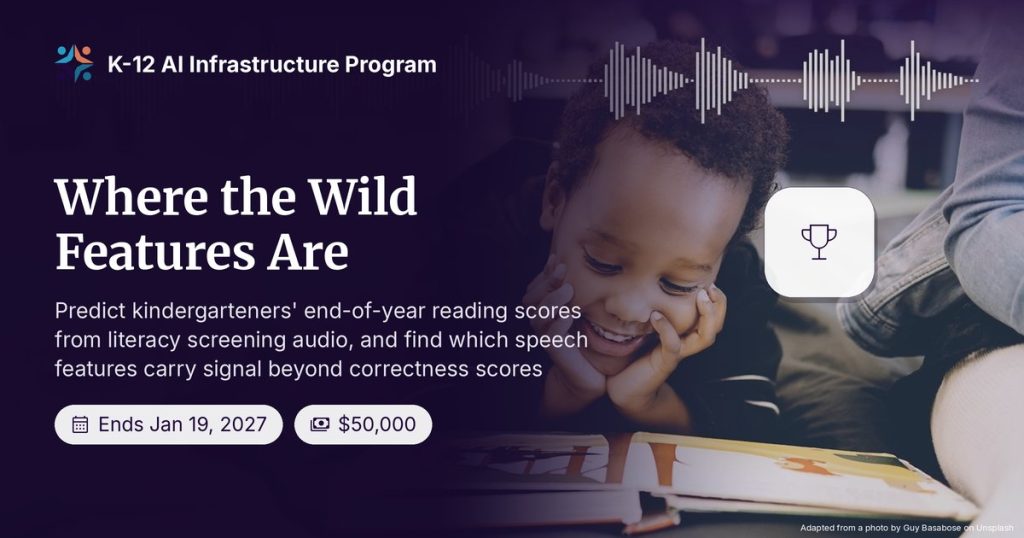
Use kindergarten beginning-of-year literacy screening scores and audio to predict end-of-year reading scores and find additional predictive signal from acoustic features.
speech analysiseducation prediction
AI brief
Paste it into ChatGPT, Claude, Gemini or any AI chat and it will understand this contest
Contest brief for your AI
Below is a brief on an AI competition, compiled from its official website and last checked on November 24, 2026. Read it first, then help me as asked at the end.

# Where the Wild Features Are
- In one line: Use kindergarten beginning-of-year literacy screening scores and audio to predict end-of-year reading scores and find additional predictive signal from acoustic features.
- Organizer: MIT Gabrieli Lab, hosted on DrivenData
- Official site: https://platform.k12-ai-infrastructure.org/competitions/4/literacy-speech-modeling/
- Format: Write-up competition, judged on a submitted report
- Prize pool: $50,000, top prize $20,000
- Prizes: First place $20,000; Second place $15,000; Third place $10,000; Fourth place $5,000
- Dates (UTC): Starts Nov 19, 2026 00:00; Registration closes Jan 19, 2027 23:59; Submission deadline Feb 8, 2027 23:59
- Who can enter: Open to natural persons aged 18 or older (or the age of majority in their place of residence). Excludes U.S. OFAC sanctioned countries and territories and the Russian Federation.
- Team: up to 5 people
- Entrants: 131 registered (as of November 24, 2026)
- Focus: speech analysis, education prediction

## Details
### What to build
Use beginning-of-year literacy screening scores and audio to predict end-of-year reading scores. The competition has two stages: first use a model to make predictions, then explain which acoustic features provide predictive information beyond the screening scores.

### Prizes
- First place: $20,000
- Second place: $15,000
- Third place: $10,000
- Fourth place: $5,000
The top 15 teams on the private leaderboard are invited to submit write-ups, and judges select the top four. Winners must submit reproducible code and release their solution under the MIT license.

### Judging
A panel of domain experts selects winners based on rigorous analysis of the write-ups, focusing on whether acoustic features provide predictive signal beyond the screening scores.

### What to submit
- Stage 1: Submit test set predictions, up to 3 times per day
- Stage 2: Submit a PDF write-up describing the acoustic features you found
- Top 4: Submit reproducible code

### Eligibility
Open only to natural persons, at least 18 years old and the age of majority in your place of residence. Excludes U.S. OFAC sanctioned countries and territories and the Russian Federation. Participants from China are eligible.

### Notes
- Test set must not be manually labeled or used for training; predictions must be generated by code.
- External data and pretrained models must allow commercial use, such as CC0 or CC-BY.
- Do not upload competition data to third-party services such as ChatGPT, Claude, or Gemini.

## Please help me
1. First open the official site and compare them with this brief. Where they differ, the official site wins, and tell me what is different. If you cannot browse, say so, work from this brief, and list what I should double-check myself.
2. In plain words, explain what this competition asks for and what the judges care about, then tell me whether it is worth doing given the prize, the number of entrants and the difficulty.
3. Give me a plan to complete it with AI. Assume I work alone with common AI tools: what to build, how to build it, which kind of AI tool handles each step, and roughly how much compute or API spend it takes.
4. Convert the deadline to my time zone, work backwards from it into a schedule, and end with the list of things I have to submit.
Timeline
Your time zone: UTC
Starts
Registration closes
Submission deadline
Prizes
First place$20,000
Second place$15,000
Third place$10,000
Fourth place$5,000
Details
What to build
Use beginning-of-year literacy screening scores and audio to predict end-of-year reading scores. The competition has two stages: first use a model to make predictions, then explain which acoustic features provide predictive information beyond the screening scores.
Prizes
First place: $20,000
Second place: $15,000
Third place: $10,000
Fourth place: $5,000
The top 15 teams on the private leaderboard are invited to submit write-ups, and judges select the top four. Winners must submit reproducible code and release their solution under the MIT license.
Judging
A panel of domain experts selects winners based on rigorous analysis of the write-ups, focusing on whether acoustic features provide predictive signal beyond the screening scores.
What to submit
Stage 1: Submit test set predictions, up to 3 times per day
Stage 2: Submit a PDF write-up describing the acoustic features you found
Top 4: Submit reproducible code
Eligibility
Open only to natural persons, at least 18 years old and the age of majority in your place of residence. Excludes U.S. OFAC sanctioned countries and territories and the Russian Federation. Participants from China are eligible.
Notes
Test set must not be manually labeled or used for training; predictions must be generated by code.
External data and pretrained models must allow commercial use, such as CC0 or CC-BY.
Do not upload competition data to third-party services such as ChatGPT, Claude, or Gemini.