What to build
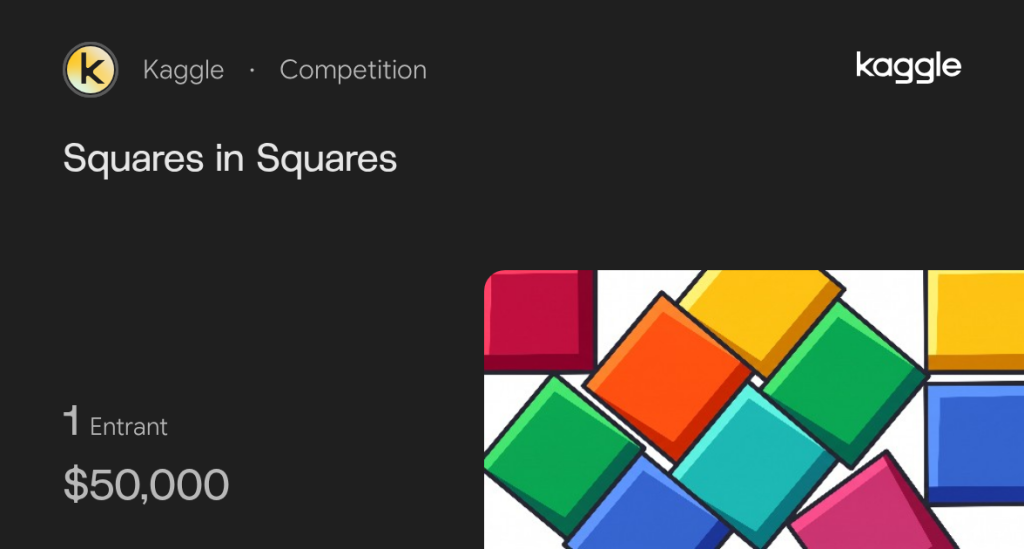
A classic problem in combinatorial geometry: pack n unit squares without overlap into the smallest possible axis-aligned square container. n ranges from 1 to 1,000, for 1,000 problems in total. Only a few optimal solutions have been proven; the rest only have best-known results that can be improved.
For each problem, provide the center coordinates (x, y) and rotation angle (in radians) for all n squares. No two squares may have overlapping interiors.
Data
No competition dataset is provided, only a sample_submission.csv format example.
Prizes
Total prize money: $50,000. Final ranking: 1st place $12,000, 2nd place $10,000, 3rd place $8,000, 4th and 5th places $5,000 each.
There are also two stage prizes of $5,000 each, awarded to the team at the top of the leaderboard at the two checkpoints of 07:59 Beijing time (UTC+8) on January 18, 2027 and April 19, 2027. If tied, the earlier submission wins.
Judging
- Each problem scores score(n) = L / √n − 1, where L is the container side length computed from your coordinates and angles; lower is better.
- The leaderboard score is the sum of scores across all problems.
- Problems not submitted are scored using the side length L0 of an ordinary grid arrangement, i.e., L0 / √n − 1; problems whose coordinates cannot be parsed are also scored at the grid upper bound.
- If scores are tied, the earlier submission ranks first.
What to submit
- A CSV with one row per square and columns id, n, square_id, x, y, angle. id is the zero-based row number, and square_id is the problem-specific index from 0 to n−1.
- Coordinates should be ordinary decimal numbers; scientific notation is allowed. You do not need to submit L; it is computed by the scoring code.
- You may submit only some problems; you do not need to submit all 1,000 at once. Upload the file directly; you are not required to use a Notebook.
- You may submit up to 10 times per day, and you must select 1 submission for final evaluation.
- Winners must submit code, documentation, and runtime environment instructions that can reproduce the winning results. Code and submissions must be open-sourced under CC BY 4.0 or Apache 2.0; if you use external data or pretrained models with incompatible licenses, those parts do not need to be open-sourced.
Notes
- External data, models, and tools (including LLMs) may be used if not prohibited by the organizer, but they must be publicly available for free to everyone, or reasonably priced. Example from the rules: buying a private dataset more expensive than the prize may not be considered reasonable.
- The competition runs for 9 months. Registration closes at 07:59 Beijing time (UTC+8) on July 12, 2027, and submissions close at 07:59 Beijing time (UTC+8) on July 19, 2027.